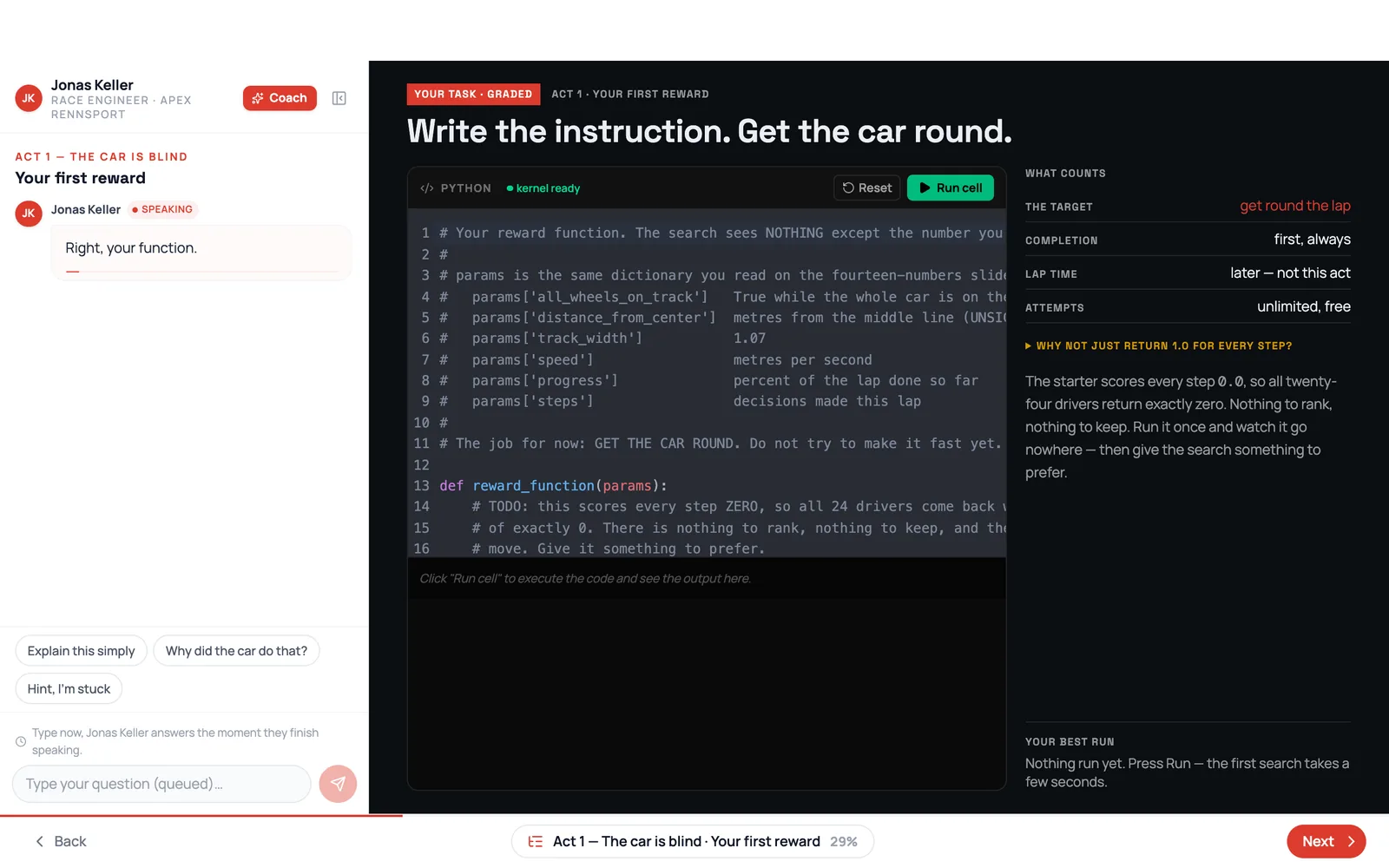
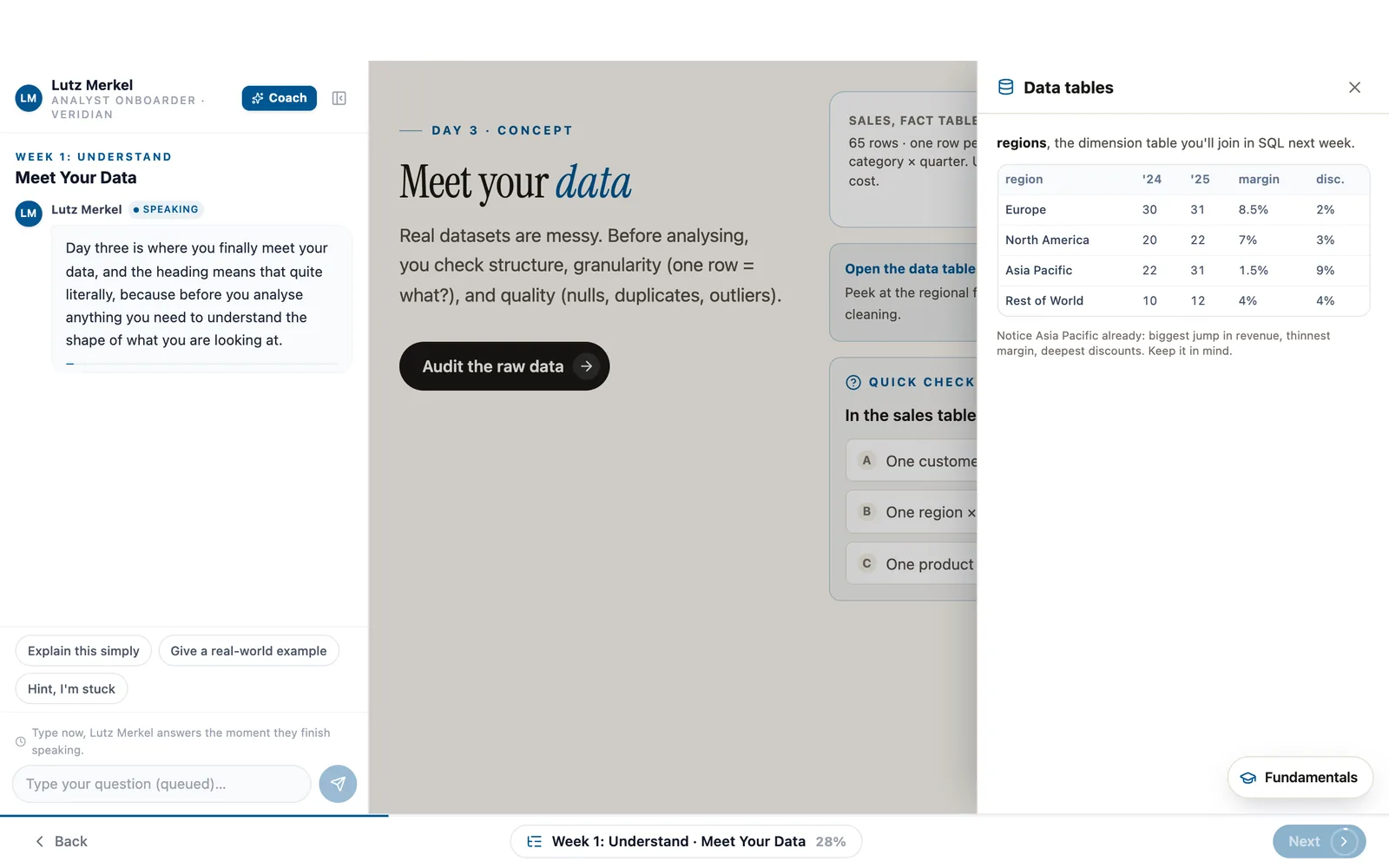
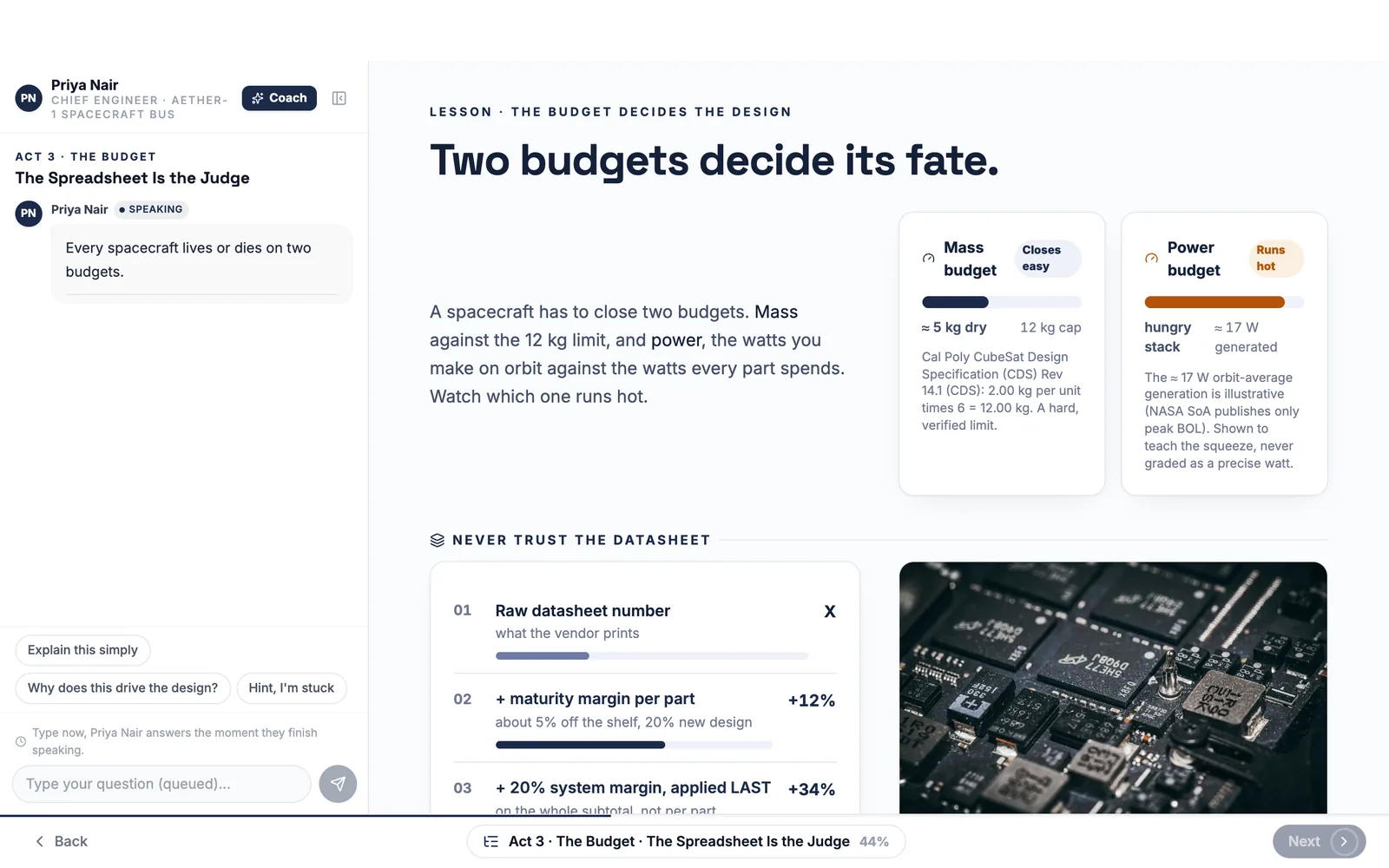
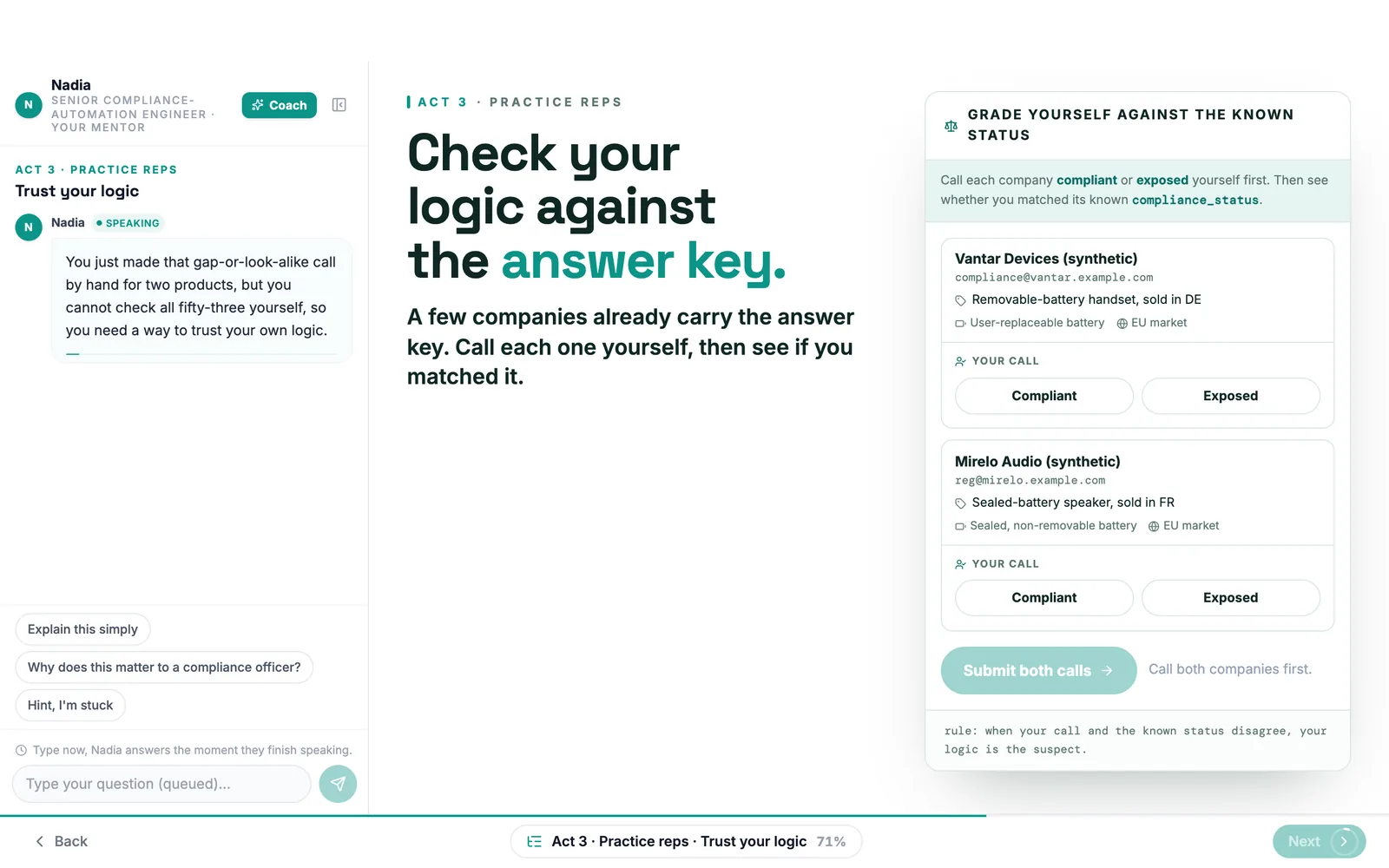
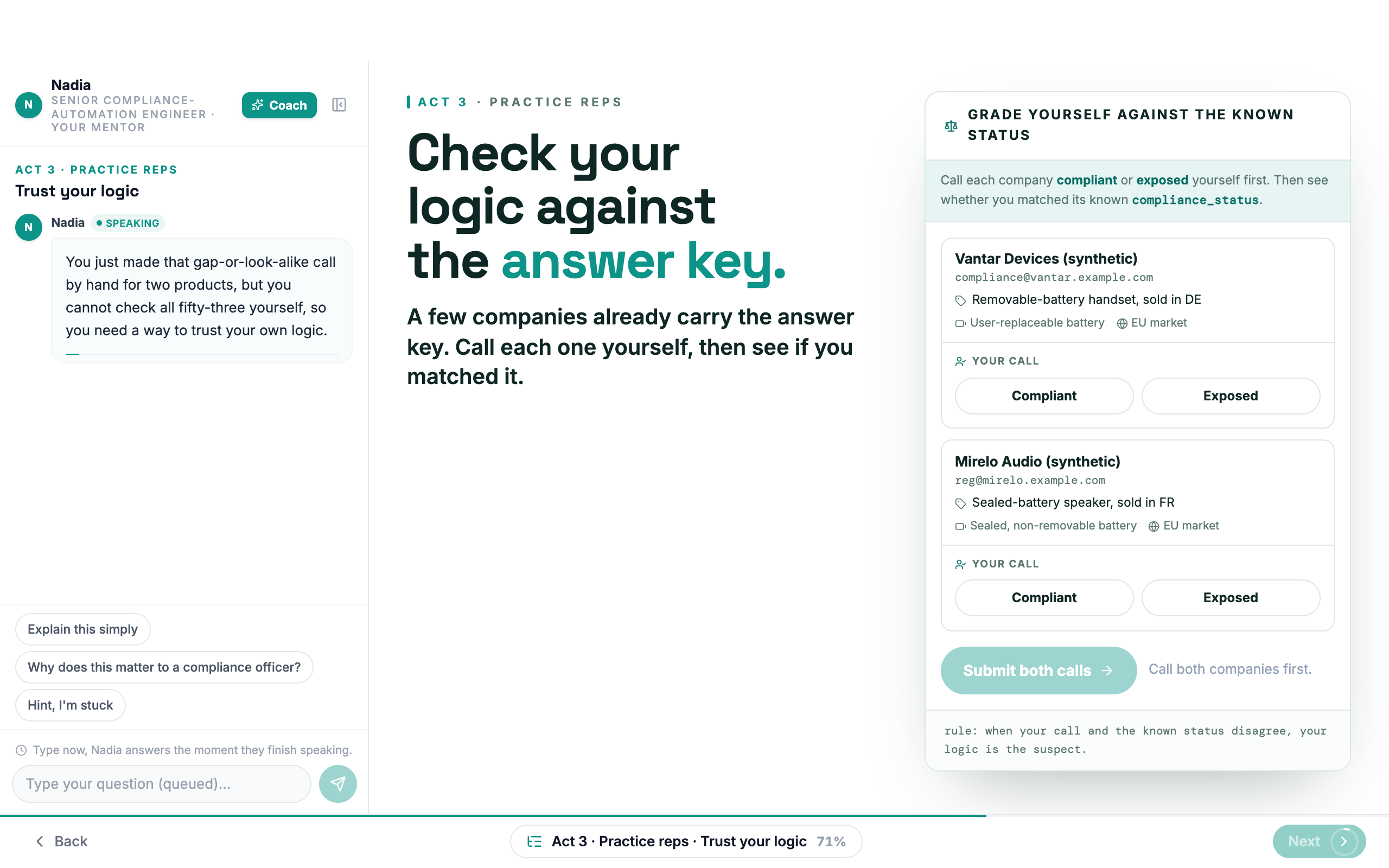
We build each challenge by hand as a guided online experience: real code, data and tools run in the browser, an AI mentor answers as they work, and every step is scored on your rubric and checked by a person.
A campaign is a set window in which students on ProoV work on one real task from your company: a guided challenge over a few weeks, or a hackathon over a weekend. You give us the brief. We turn it into a hands-on experience they do in the browser, on your tools and your kind of problem, and we score every submission. Every student who finishes earns a verified certificate with your name on it. You get the work, the people who did it, and a page that stays live after the campaign ends.
3,552 students from 40+ countries have worked on ProoV so far, across 2,313 enrolments. The most-enrolled challenge drew 398 students on its own. Thirty challenges are live today; yours would sit next to them. Measured on the platform, 23 August 2026.
A banner buys a glance. A challenge buys the hours a student spends inside a problem shaped by you, and the page they come back to with your name on it.
What it takes off your plate:
The campus tour
No fairs, no goodie bags, no travel. Your name sits on a challenge page students open from their own desk, and share.
The attention
A student spends hours inside a problem shaped by you, not seconds on an ad, and rates it when they finish.
The shelf life
The page stays published after the campaign, so every new intake finds it.
The audience
Yours, ours, or both. Bring your own channels; we add the students already on ProoV.
Some problems want more minds than a department has. Set the brief, the constraints and the window. Teams take it on, and every submission comes back to you scored and readable.
What it takes off your plate:
The idea drought
Set one open problem and its constraints; teams take it on for a weekend or a month, and none of them are on your payroll.
The legal worry
Nothing proprietary leaves the building. You set the problem without handing over your data.
The pile of PDFs
Every submission comes back scored and ranked; you read the ones worth a second look, not all of them.
The follow-up
The teams behind the best ideas are named and reachable, with the work attached.
A hackathon is a challenge with a clock on it: one brief, a weekend or a week, teams or solo, all in the browser. No hall to book, no travel, no cap on how many can join. Your audience or ours.
What it takes off your plate:
The organising
No venue, no catering, no weekend staff. You give us the brief and the dates; we build the challenge and run the event online, end to end.
The audience
Bring your own: your students, your community, your event. Or use ours, or both. Either way they sign up in a minute and build in the browser.
The judging
You do not read every submission. They come back scored and ranked; you read the top and pick the winners.
The morning after
Finishers keep a certificate with your name on it, you keep the ranked list of who did the work, and the challenge stays live for the next intake.
A hiring campaign is a pre-screen we build around the job: a challenge on your kind of work that candidates do before anyone applies. It ends with a ranked view of who did the work. Not CVs. Scored work.
What it takes off your plate:
The pre-screen
Built for the role, on your kind of work. Candidates do it first, so the pipeline starts with people who have already done the job in miniature.
The CV pile
You start from a ranked list of people who did that work, not from applications.
The guessing
Each candidate comes with the work they did, so the first interview starts there.
The screening hours
A shortlist in a click, with the numbers for your report.
The usual suspects
Merit-ranked across every university and country the campaign reached. Where you hire from is your call.
You bring a challenge area and sign off the name and logo. We do the rest: build, run, score, report. No mentor time, no HR load, none of your data. Every experience runs on the world’s best hands-on learning and assessment technology.
You bring the brief
A challenge area, and a sign-off on the spec, the name and the logo. About fifteen minutes.
We build it
A hands-on, graded experience in the browser, with your name on it. Ready in a few weeks.
Students do it
Yours, ours, or both. Teams or solo, a window, a deadline.
You get the results
Every submission scored and ranked. A shortlist, the numbers, and a page that stays live.
Talk to us.
A first call is thirty minutes. Bring the product, the problem, or the team you are hiring for.
What we cover:
Which of the five you want first: awareness, adoption, innovation, a hackathon, or hiring.
The audience: yours, ours, or both, and where they are.
The build: what the challenge runs on, and what comes back to you.
From the ProoV Journal
The honest read on German automotive hiring right now
German automotive is restructuring in public, and students read that as a warning to stay away. The more useful read is which skills the industry is buying now.
Free certificates worth getting as a student in Germany
A genuinely useful roundup of free ways students in Germany can earn verifiable proof of skill in 2026, and the certificate mills worth skipping entirely.
Tokenised real-world assets, explained without the hype
What putting a bond or a fund share on programmable rails actually adds, what it does not fix, and the roles beyond development that this space is creating.